Wednesday, November 8, 2017
Wine Bloggers Conference Starts TODAY!
A little over two years ago I watched the movie SOMM and decided to start a blog documenting my WSET Diploma wine education adventures. It has been a long, hard journey and I am still in the process of securing my Diploma certification! Only one exam separates me from this (read more HERE)!
Within a week or so of starting my blog I stumbled upon something called the Wine Bloggers Conference online. This conference has been the backbone of my blogging journey. I have met many wine bloggers and learned a lot along the way. I’ve explored regions I had never visited before, such as the Finger Lakes in New York and Lodi in Northern California. It is safe to say that the Wine Bloggers Conference is one of the highlights of my year. It’s the time of year when I’m with “my people”. When you love wine as much as I do, it can be difficult (and a bit lonely) to be around people who do not appreciate the artistry of wine as I do. And I don’t mean that in any sort of snobbish or “better than” way. There is something magical to be with a group of people who have the level of appreciation that you do for something. I also feel an escape when I am at WBC each year. Escape from the real world, work, doctors appointments, Trump(?), cleaning house, obligations, etc. I get to live for a week with a bunch of cool wine geeks like me, taking notes, tweeting, and snapping pics. It is the only time in my life where it is socially acceptable (and encouraged!) to constantly be on your phone, ipad, or laptop. The challenge is to balance all of that with actually meeting and connecting with people. And what better way to do that than through your shared love of wine!
This year the wine bloggers conference will take place in the Santa Rosa/Sonoma area. This is an area I have explored many times on my own, however, I never tire of it. The area was recently devastated by a series of wildfires, which the conference will address head-on. There is a seminar on the topic and I am sure we will meet bloggers, winemakers, and representatives who lived through the tragedy and who will bravely share their stories.
The Wine Bloggers Conference starts TODAY with an optional pre-conference excursion called the “Inner Mendo Odyssey” hosted by Fetzer-Bonterra where we will have conversations about sustainability and biodynamics as it relates to the wine industry. This two-day excursion includes a reception, dinner, blending competition, and multiple seminars.
Tomorrow evening, the conference officially begins with an Expo featuring Wines of the World and an Opening Reception.
Friday we start digging into the content. Sessions include: Professional Wine Writing Tips, What Companies Want from Wine Bloggers, Wine Discovery Session: Carinena, Keynote Speaker Doug Frost, as well as Live Wine Blogging. That evening I’m participating in a Vineyard Dinner at Thomas George Estates.
Saturday brings more content: Advanced Social Media Beyond Hashtags and Likes, Pitch Perfect: A Look at the Blogger-PR Relationship, Wine Discovery Session: An Exploration of Alsace’s Pinot Gris Styles, Wine County Fires, and How Media Can Respond to a Crisis. We’ll also have more Live Wine Blogging as well as our closing dinner (sponsored by NakedWines.com) in which the announcement of the 2018 conference location is made.
In a nutshell, that’s what I’ll be up to in the next 4 days. I will not be blogging during this time, but I will be VERY active on social media. Follow me on Twitter, Facebook, and Instagram. Direct links are to the right.
Thank you and what’s in your glass this week?

Monday, November 6, 2017
Cabernet Sauvignon Masterclass: The Great Grape

In late Spring I was honored to be invited to a Cabernet Sauvignon Masterclass. The event was hosted by Louis M. Martini Wines and our fearless leader for the day was Christy Canterbury, MW. The backdrop was the lovely Redbird restaurant in the heart of downtown Los Angeles.
Cabernet Sauvignon is a grape we all know a lot about. It is, perhaps, the most popular and ubiquitous grape on the planet. Ask any wine-drinking novice about Cab, and they'll have something to say. Whereas if you ask them about Aglianico del Vulture......crickets.
This was a wonderful Masterclass for me to participate in, as I was preparing for my final WSET Diploma exams. Cabernet Sauvignon is a grape I can get cocky about. I know about the actual varietal, I know about how it expresses itself in classical growing regions, and I know what I do and don't like about it. But sometimes it behooves us all to take a step back and go back to the basics. This is exactly what I did at this event and it proved VERY helpful to my understanding of this grape. And very helpful as I prepared for my final exams.
Louis M. Martini: A Bit of History
Louis M. Martini founded the winery in 1933 (the day after Prohibition was repealed) in St. Helena in the Napa Valley. Martini grew Cabernet Sauvignon and also tended Zinfandel vines planted onsite as early as 1890. He was one of the founders of the Napa Valley Vintners Association in 1943, which sought to promote Napa Valley wines around the globe. Louis M. passed the winemaking torch to his son, Louis P. in 1954. Next in line was Mike Martini who took over in 1977. Louis M. Martini now has many holdings in California and makes wines from Sonoma Valley, Alexander Valley, and Napa Valley.
It was awesome to taste these wines as I rarely get to taste iconic or benchmark wines. I'm not a somm on a restaurant floor with access to these wines and I certainly don't have the budget to buy them on my own. To have the opportunity to taste these wines that I have read/studied about was a real treat. Note that the Louis M. Martini Lot 1 Cabernet Sauvignon was used as the first wine in each flight. That way we could compare and contrast this wine to other benchmark wines from classic regions. It allowed me to ground myself in a Napa Cab and then take off wherever we were going: staying in Napa, through the rest of the US, or across the globe.
Global Cabernet Sauvignon Flight
2013 Louis M. Martini Lot 1 Cabernet Sauvignon, Napa Valley, CA $145
This is clearly a New World wine because the fruit takes a major lead. No supporting role here. Bold black fruit, which signifies to me a warmer climate. Medium + well-integrated tannins.
2013 Chateau Palmer, Margaux, Bordeaux $250
This wine has an Old World nose, that included fruit plus earth. More undestated, a bit dusty and older feeling, though it was the same vintage as the others. This felt like cooler-climate black fruit, with some red fruit as well. Medium - dusty tannins. This was my favorite wine of the flight for its austerity and restraint. Truly a distinct wine. 49% Merlot, 51% Cab
2013 Almaviva, Puente Alto, Chile 15% ABV $100 (72% Cab Sauv, 19% Carmenere, 6% Cab Franc, 2% Petit Verdot, 1% Merlot)
This wine screams Chile on the nose: capsicum, pyrazines, green bell pepper. As it turns out, I have a very strong nose for the "green" notes, so this stood out for me, though the wine was in no means unripe or subpar. A joint venture between Rothschild and Concha y Toro. I also credit this wine with helping me on my Diploma Unit 3 tasting exam 1 month later. On the exam we had a flight of 3 wines presented to us that were all the same predominant variety. With my tasting flights, I always search for the marker. Which wine in this flight is a sure thing (meaning I know what I am drinking)? If I can find and ID the marker, then I can start deducing what the others could be. The flight is in front of me and I smell all three. One has heavy pyrazines. From there it all came together. One was Napa, one was Bordeaux, and the "green" one was Chile. I incorrectly called the flight predominantly Cabernet Sauvignon, when it was in fact predominantly Merlot, but I still think I acquired enough points in the appearance, nose, and palate to "pass" this flight. Note: I did pass this flight on the exam! And I give partial credit to having tasted this wine!
2013 Tenuta San Guido Sassicaia, Bolgheri, Tuscany $170 (85% Cab Sauv, 15% Cab Franc)
I was in my own little hog heaven with this wine. To finally taste a Sassicaia was so awesome! These guys have been credited with starting the Super Tuscan craze. The wine has a much more restrained nose than I thought it would have. There is a beautiful, sweet spice nose and young, juicy red fruit on the palate.
2013 Vina Cobos Volturno, Lujan de Cuyo, Mendoza $200
Lujan de Cuyo has a slightly higher elevation than the rest of Mendoza, at about 3300 feet. Red and blue fruit plus smooth, integrated medium tannins. Has a bit of Malbec blended in.
Iconic US Flight
2013 Louis M. Martini Lot 1 Cabernet Sauvignon, Napa Valley, CA $145
Hello Napa!
2012 Silver Oak, Alexander Valley, Sonoma $70
Some green notes here, including pine/dill from the American oak.
2014 Ridge Estate, Santa Cruz Mountains $55
This fruit is from an extremely coastal and cool climate. Lots of berry fruit here (both red and black). A medium to medium - finish.
2013 JUSTIN, Isosceles Reserve, Paso Robles $70
Black fruit (almost sunburned). Medium - aroma intensity. 16.5% ABV on this bad boy, but did not feel that hot.
2014 Peter Michael, Les Pavots, Knights Valley $230
This was my favorite wine of the flight. Knights Valley is between Napa and Sonoma, yet this wine shows more Napa because it's warmer/riper. Concentrated "mountain" fruit from very low-yielding vines. Juicy red/black fruit (plum and cherry) that is a bit jammy, almost preserve-like. A savory note that Christy says comes from the volcanic soil.
2012 Leonetti Reserve, Walla Walla Valley $170
The Cascade Mountains create a desert in Washington, which give burning hot days and freezing nights (translation=wide diurnal range), which makes for very dramatic wines. The nose in this wine was very unusual, so much so that I didn't have any good descriptors! Blueberries on the palate. In my opinion, this wine needs 5-6 years before it's truly ready for drinking.
Napa Flight
2013 Louis M. Martini Lot 1 Cabernet Sauvignon, Napa Valley, CA $145
Hello again Napa!
2013 Dumn Vineyards, Howell Mountain, Napa Valley $150
This was my favorite wine of the flight (actually I had 2). Howell Mountain is the highest AVA in Napa at 1500 feet. Everything is grown over the inversion layer (which is where the temperature begins to increase past a certain altitude). It's a warm AVA that does not have a wide diurnal range. Savory notes almost make me think this is an Old World wine, BUT the fruit is quite prevalent, so it takes me to the New World. Tannins here are mind-blowing. My tannin note was: woah.
2013 Robert Mondavi, To Kalon, Oakville $140
This is "valley floor" fruit. Red berries and sweet spice on the nose and palate.
2013 Stag's Leap Wine Cellars, Cask 23, Stag's Leap, CA $240
A masculine wine. Serious (grainy) tannins with an herbaceous/eucalyptus note on the back palate. This wine is the "densest" of the flight. A big boy.
2013 Krupp Brothers Winery, M5, Napa Valley $200
Wow. Lovely, mouth-pleasing fruit with drying tannins. A meal in and of itself!
2013 Chappellet, Pritchard Hill, Napa Valley $180
Volcanic soils lend minerality to this wine. A perfect combination of rocks and fruit. One of the best wines I tried today.
Side note: I'm convinced that once you become am MW/MS, you are required to use RIDICULOUS nose/palate descriptors. And I don't mean this as a criticism! It actually cracks me up. My favorite tasting note used at this seminar was "fallen branch". Not the branch ON the tree, but the branch after if fell! Seriously. Is there a difference? All kidding aside, Christy was right. There definitely was a twigginess to one of the Cab Sauv/Cab Franc blends!
In addition to these incredible wines, lunch was delicious. A well put together event (from the event planner in me!).
Tuesday, September 12, 2017
Exam Results Are Here!

After 12 LONG weeks waiting for my test results, they are here!
Let's recap. In June of 2015 I embarked on a 2-year adventure known as the WSET Diploma program. This program consisted of 20 in-person classes, 6 exams, and 1 research paper on topics including the wine business, viticulture (grape growing), vinification (winemaking), spirits, fortified wines, sparkling wines, and still wines of the world. Leading up to the last exam on June 14 I passed all 5 exams I attempted and passed the research paper. Only 1 exam separated me from my WSET Diploma certification: the dreaded Unit 3 exam. This exam is (roughly) 4x the size of the other exams. It consists of 12 blind tastings and 5 essay questions. However hard you think this exam is, I'd say to multiply that by about 5. It's an unreasonable amount of information to prepare for and to retain for this one exam.
Over the last 5 years the average pass rate on the theory portion is 48% and 70% for the tasting portion. See HERE for my impressions immediately after the exam. I didn't state it in the blog post, but my gut was that I passed the tasting portion (that was the easy part, right?). I wasn't so sure about the theory exam. That one was a doozy and everyone will admit is the more difficult of the 2 exams.
Here we are and yesterday I receive an email with the subject line: WSET Diploma-Unit 3 Exam Results. YIKES!! I didn't even blink, take a breath, or think, I just clicked "open".
If you are reading this email, this means that you passed the theory paper you took for Unit 3 last June. Unfortunately you did NOT pass the tasting portion of the exam.
Wow, really? I was SO happy, yet so bummed. I managed to pass the more difficult part of the exam yet fail the easier part? How is this possible?!?!? I didn't know whether to cry or jump for joy. I've had a few hours to process this and I can say that I am VERY relieved. The theory portion of the exam is a monster. I put in over 300 hours of theory study alone and only had to use about 5% of my knowledge for the exam. On the other hand, the tasting exam is straight-forward. I just need to taste more...bottom line. If I taste more, and practice ONLY in exam conditions, I am sure to pass. No doubt.
That's where I am. I'm incredibly proud of how far I have come. And believe it or not, I look forward to immersing myself in tasting over the next few months and tacking the last, and final tasting exam that separates me from my WSET Diploma certification.
Stay tuned as I decide when to take the re-sit of my tasting exam. Cheers and thank you to all the support from family, friends, and you, my readers. Every note of support and encouragement is greatly appreciated!
Event Recap: Tre Bicchieri

Back in February I had the opportunity to attend the Tre Bicchieri tasting put on by Gambero Rosso at the Barkar Hangar in Santa Monica. Gambero Rosso is a multimedia brand in the Italian food and wine world that includes: food guides, wine guides, books, a TV channel, a learning academy, and events around the world. The Tre Bicchieri tasting brings together all the highly rated wines that make it into their Vini d'Italia annual guide. The guide is now in its 30th edition. Over 45,000 wines are tasted annually by special committees involving over 70 people. Wines that make the cut in the guide are rated one glass (bicchieri), two glasses (due bicchieri), or three glasses (Tre Bicchieri).
The Grand Tasting showcased over 200 wines of all 3 levels detailed above. I didn't spend much time there, as I was lucky to receive an invite to the Vini d'Italia Special Awards Masterclass. Here we tasted through 9 wines that were the "best" in their respective categories. Tasting notes are below:
Sparkler of the Year: Ruggeri
Valdobbiadene Extra Dry Giustino B. 2015
A good balance between fruit (citrus, stone fruit, and green fruit) and white flower. Creamy mousse, elegant, fresh, drinkable.
Winery of the Year: Bellavista
Franciacorta Pas Opere 2009
65% Chardonnay, 35% Pinot Noir. WOW. This wine has spent 6 years on the lees, so it is totally my jam. Notes of: citrus, apple, and stone fruit (peach). Also, yellow flower, leesy (yet fresh!), and nutty. Medium + finish.
Grower of the Year: BioVio
Riviera Ligure di Ponente Pigato Bon in da Bon 2015
BioVio has been certified organic since the 80s; they were one of the first. Pigato is a native grape of Liguria. This wine has citrus notes (lemon and grapefruit) and a perfumed elderflower nose. One of the panelists exclaimed that this wine has GPS; it takes you immediately to Liguria. In my opinion this wine would shine with food.
Award for Sustainable Viticulture: Roccafiore
Todi Grechetto Superiore Fiorfiore 2014
2014 was one of the most challenging vintages in Italy in over 20 years, which included summertime rain. This wine has medium - aromatic intensity with yellow apple and a toastiness due to oak treatment. It is full-bodied and round with great structure, is very well integrated, and has an elegant finish.
White of the Year: Tenuta di Tavignano
Verdicchio die Castelli di Jessi Classico Superiore Misco 2015
A textured wine with good body. Notes include: lemon peel, nuts, and a smokiness. Great acid. Would be kick ass with some seafood.
Best Value for Money: Tiberio
Pecorino 2015
This was an interesting wine that I thoroughly enjoyed. On the nose alone, this appeared to be a basic, daily drinker. Notes of citrus (lemon), a slight nuttiness, wet stone, and vegetal, white pepper quality. Has a Sauvignon Blanc-like feeling to it, but the acid is not as high.
Up and Coming Winery: Istine
Chianti Classico LeVigne Riserva 2013
It is hard to find an "up and coming" winery in Italy, because they have all been there so long! On the nose there is red fruit (cherry and strawberry), spice (black pepper and cloves), and floral (violets). The wine is earthy/meaty on the palate and has good acid, as can be expected from a Chianti.
Red of the Year: Chiaromonte
Gioia del Colle Primitivo Muro Sant'Angelo Contrada Barbatto Classico 2013
This is a lovely and interesting wine from Puglia. It has 16.5% ABV but does not feel as that hot. Red/black fruit (sour cherry, blackberry, plum) with some of the fruit feeling stewed (Amarone-like?). The wine also had a mocha/chocolate note as well as meatiness/gaminess (dried meats). Overall, this was the most interesting thing I tasted today. Meaty, perfumed, AND funky on the nose. The palate was smooth, velvety, and mouthfilling.
Sweet of the Year: Lis Neris
Tal Luc Cuvée Speciale
95% Verduzzo, 5% Riesling. For this wine, the grapes are dried passito-style. The wine is honeyed with notes of tropical fruit, chamomile, and spice, including rosemary/garrigue.
Thursday, September 7, 2017
Spotlight Italy: The Wines of Lugana DOC

There are many well known Italian wines that we are all familiar with (i.e. Prosecco, Chianti, Barolo, etc), but there are a ton of lesser known Italian wine regions. Wine is such a fragmented industry with consumers facing shelves upon shelves of choices. Lugana is not a choice many consumers see on their local shelves, as it is a smaller DOC with most of the wine production consumed within the region.
I had the pleasure of attending two different Lugana DOC wine events in the Los Angeles area this year. In April I was invited to the Valpolicella & Lugana tasting put on by the Consorzio Tutela Vini Valpolicella and the Lugana DOC Consorzio Tutela. And just last week I attended a Lugana luncheon conducted by Laura Donadoni (Laura Wines) and put together by Cori Solomon (The Written Palette) of LA Wine Writers.
Lugana DOC is located between Lombardia and Veneto on the south shore of Lake Garda. The Lugana region has a Mediterranean climate, but Lake Garda gives maritime influences including cool breezes and relatively mild weather. Lugana DOC was the first all white wine DOC in Italy. Turbiana, which is a clone of Trebbiano specifically grown in Lugana, is the sole white grape used. All wines are monovarietal. Sometimes the grape is referred to as Trebbiano di Lugana.

The Valpolicella & Lugana tasting took place at the beautiful and recently renovated Park Plaza Hotel. While Valpo and Lugana wines are VERY different, it makes sense to pair the tasting as we are in the same gegraphic region. Also, Lugana wines are all white, while Valpolicella wines are just about all red. Some highlights from this trade tasting include:
Villa Canestrari
This is a family winery with its 4th generation winemaker at the helm. The Museo del Vino onsite showcases old winemaking equipment and tools that have been used since the winery’s opening in 1888. I thoroughly enjoyed their Amarone della Valpolicella DOCG 2012 “A”.
 |
| Shots from the Museo del Vino |
 |
| Loving this Amarone |
The award for most interesting wine I tasted at this event goes to Cantina Bulgarini Fausto with their Lugana DOC Superiore 2014 “Ca’ Vaibo”. The grapes for this wine undergo a short drying period before pressing. The final wine is a straw-yellow color (almost gold) and has notes of stone fruit (peach, apricot) along with a strong nuttiness.
 |
| Cantina Bulgarini |
The most recent Lugana event I attended was the Lugana Luncheon put together by Cori Solomon with the LA Wine Writers Group. Laura Donadoni walked us through her portfolio of Lugana wines beautifully paired with the cuisine of Cafe del Rey by Executive Chef, David Vilchez. See details below on each pairing. Each course was better than the next. I could have eaten a plate full of each of them! I’m hungry again just thinking about it…….
 |
| Laura Donadoni telling us about Lugana |
1st Course
Amuse Bouche: Seafood Salad on Toast
Pairing: Cascina Maddalena, Lugana Brut, Metodo Classico ($20 retail)
This was an unexpectedly delightful bubbly made in the Metodo Classico (2nd fermentation happens in the bottle). It is crisp with good fruit (citrus and yellow apple) plus white flower notes. What I love is that you also get nice creamy, yeasty, and brioche flavors from bottle fermantation, yet it is still very fresh and clean. This is a nice Champagne alternative at about half the cost of an opening pricepoint Champagne.

2nd Course
Smoked Salmon, Pita, Tzatziki, Mixed Greens, Olive Vinaigrette
Pairing: Montonale, Lugana DOC 2015
This is my White Wine Summer Pick. Clean, refreshing, and a nice honeyed quality, yet bone dry. It's also got a nice medium + body and creaminess that comes from battonage (lees stirring for 6 months).

3rd Course
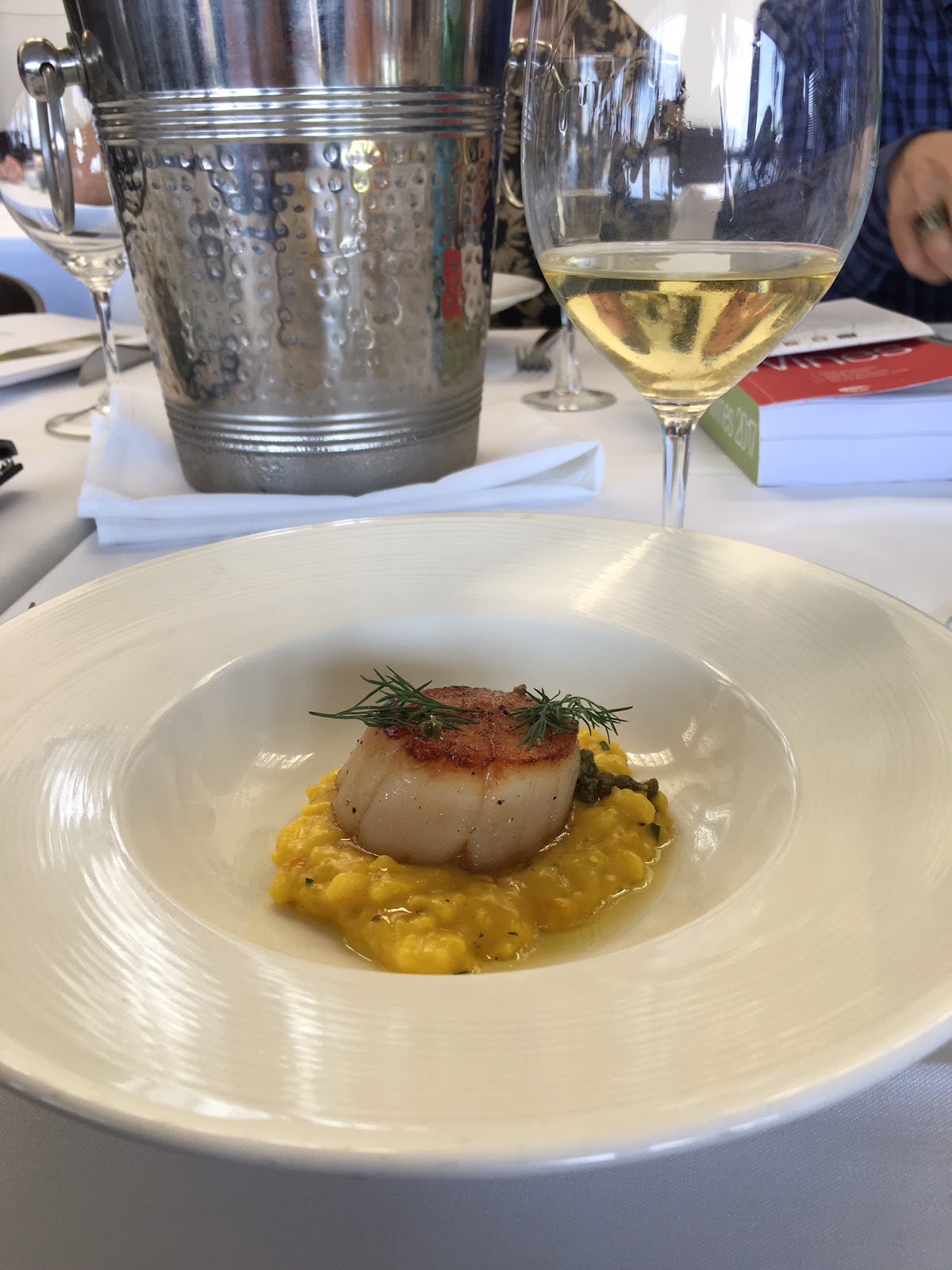
Seared Scallop, Saffron Risotto, Capers, Olive Oil
Pairing: Ca’ Lojera, Lugana Superiore 2014
I love this wine. It is more honeyed than the basic Lugana DOC and has great structure and acidity. Once the wine got closer to room temperature, it developed a super nutty (almond skin) quality. The scallop risotto pairing was OUT OF THIS WORLD.
4th Course
Swordfish, Squash Blossom, Passion Fruit Vinaigrette
Pairing: Zenato Lugana Riserva 2014
Zenato is famous for their Amarone wines, but they also have holdings in Lugana. Great viscosity on this wine, which paired famously with the swordfish. A beautiful orange blossom nose.

Dessert
Bucheron Cheese, Grilled Peach, Honey, Sourdough
Pairing: Perla del Garda, Vendemmia Tardiva
This was a lovely medium dry dessert wine, that would also serve well as an aperitif before dinner. Personally, I could have a glass of this for dessert on its own!

Wednesday, August 23, 2017
Spotlight: Rhone Rangers Los Angeles Tasting & Seminar

Who are the Rhone Rangers?
Members are dedicated to promoting American Rhone wines. The Rhone Rangers was started in the mid-80s by a group of winemakers who wanted to make wines other than Cabernet Sauvignon and Chardonnay (two very popular wines of the day). In 1997 the organization was officially formed and now includes over 100 wineries and vineyards in California, Washington, Virginia, and Arizona.
As an event producer, I walk into events with a very watchful eye. Is the signage clear, does the flow of the room make sense, are the bathrooms easy to find?
The Rhone Rangers LA Tasting was very well laid out. Kudos to all involved in the planning, especially Big Red Marketing, the LA event coordinator. Upon arrival I was swiftly checked in as a member of the media and then whisked to the “Rhone-n-Pink” seminar. As described in the program: Moderated by wine expert Dan Fredman, the seminar will cover the art of crafting the popular pink wine, and feature six Rhone Ranger winemakers who will guide guests through their rosés. The wineries: Andrew Murray Vineyards, Bonny Doon Vineyard, Lone Madrone, Ranchero Cellars, Tercero Wines, and Vines on the Marycrest.
Talk about a broad range of styles. Oh, and Randall Graham is a bit of a wine celeb, in my opinion.

Wine #1
Andrew Murray Vineyards 2016 Esperance Rosé, Estate Grown $22
This was my favorite rosé of the day. It is made from 100% Cinsault and my tasting note simply states “stunning”.
Wine #2
Ranchero Cellars 2016 Galaxie Rosé, Self Family Vineyard, $28
A very easy drinking rosé made from Carignan
Wine #3
Lone Madrone 2015 Mourvèdre Rose, $25
Dry farmed vineyards and made from direct press. A soft, feminine nose.
Wine #4
Tercero Wines 2016 Mourvèdre Rose, $30
Really enjoyed this guy. This wine is not served chilled. The grapes are foot stomped on their skins for 1 hour and then direct to press. The winemaker is not going after a specific color nor vintage consistency. A very unique savory/umami nose, but still a lot of fresh fruit.
Wine #5
Bonny Doon Vineyard 2013 Vin Gris Tuilé, $26
Hands down, the most interesting wine I tasted all day. The nose is super duper nutty with an oxidized feel to it. Randall suggested notes of curry, peanut, sherry, and citrus. According to him, this wine is the ultimate handsell. The color is brick pink with an orange hue. The wine is aged 9 months al fresco in demijohn.
Wine #6
Vines on the Marycrest 2015 Rose (Genache, Syrah, Mourvedre), $28
This is a rosé for food. A skirt steak salad, perhaps? A super spicy palate. Fun.
After the rosé seminar I enjoyed early access (for trade and media) to the Grand Tasting. Now, I'll have it be known that I am not much of a grand tasting kind of gal. I find large tasting events to be overwhelming, crowded, and not conducive to efficient and thoughtful tasting. If I do attend grand tastings I be sure to walk in with a plan. I research participating wineries before I arrive and get an idea of who I am interested in visiting. There is no way to visit every table and try every wine....it's not a contest. Here are a few of my highlights from the Grand Tasting:
Martian Ranch & Vineyard 2015 "Etheric" Clairette, $22
Wow, interesting, can't compare it to anything. Med + finish. Macadamia nuts but not oxidized.
Tercero Wines 2015 Cinsault, $40
Only 3 barrels made; dirt and meat notes, yet light in color.
Two Shepherds was my favorite winery of the day. I tried their 2014 Grenache Blanc, Saarloos Vineyard (native yeast fermentation with neutral barrels; a slight funk that I like) and their 2012 Pastoral Rouge, Sonoma, Red Blend (cool climate; my favorite red of the day; savory notes plus funk, umami, soy sauce).
Friday, August 18, 2017
The Mystery of Blind Tasting
As a wine student, the most frequent question I am asked is: how do you blind taste?
While I enjoy talking about blind tasting, I don't really enjoy doing it! Why? Because it's fucking hard.
It's interesting, people are fascinated by blind tasting wines. A typical conversation goes like this:
Me: I'm a student of wine
Other person: oh, so does that mean you can guess what any wine is?
Me: <cue eye roll> no
To the layperson, blind tasting wines is a bit of a parlor trick. My least favorite thing is when people shove a glass of wine in my face and say: if you know a lot about wine, what's this? Sorry dude, that's not how it works. We're at a bar, the lighting is shit, and this wine glass is as thick as my grandma’s bifocals.
To non-wine aficionados, this sounds like the most difficult part of wine school. That, my friends, is a myth. In my opinion, blind tasting is much easier than factual recall of wine topics. And WSET statistics on pass rates for the Diploma program validate this. Unit 3 (Still Wines of the World) is the only unit of the Diploma in which the tasting exam and the theory exam are separate. The results are graded independently of each other. The tasting pass rate is much higher than the theory pass rate. For the time period of 2010-2016, on average, the theory pass rate was 40.8% and the tasting pass rate was 71.5%. Blind tasting (especially when in an academic setting) is actually quite formulaic.
Another myth about blind tasting is that it's all about calling the wine. Whether it's the grape, country, or region. Believe it or not, you could call all the wines incorrectly on a WSET Diploma tasting exam, and yet still pass the exam. The reason is that the bulk of points are granted for the assessments. The assessment of a wine starts with the appearance, then the nose, then the palate. The second part of the points come from the conclusions, which can include determining quality level, determining the grape, determining the region/country, and readiness for drinking. As a general rule, there are less conclusion points available than assessment points. A breakdown of assessment points is below. Note that I did not break down conclusion points, as those are not standardized and vary per flight.
Appearance: color (1 point) and intensity (1 point)
Nose: intensity (1 point) and aroma descriptors (5 points)
Palate: level of dryness/sweetness (1 point), acid (1 point), alcohol (1 point), tannin level and nature (2 points; this category is for reds only), flavor intensity (1 point), body (1 point), flavor descriptors (4 points), and finish (1 point).
Here are examples of 2 tasting notes (assessment portion only) from my Unit 3 studies:
Tasting Note #1
This wine is a $20 Chablis, which is a white wine from Burgundy made from the Chardonnay grape
Appearance: This wine is pale lemon with golden hues.
Nose: This wine is clean with a medium intensity. Aroma characteristics include: citrus (lemon/lime), green apple, pear, wet stone, and dairy/cream.
Palate: This wine is dry with medium acid, medium flavor intensity, medium alcohol, and medium body. Flavor characteristics include: citrus (lemon/lime), white flower, green apple, pear, and a wet stone/minerality. The finish is medium.
Tasting note #2
This wine is a $13 Valpolicella Superiore, which is a red wine from the Veneto region in Italy. Predominant grapes are: Corvina, Rondinella, and Molinara.
Appearance: The wine is deep ruby.
Nose: The wine is clean with a medium intensity. Aroma characteristics include: red fruit (cherry, raspberry, plum), vanilla, sweet spice (nutmeg and cinnamon), earthy/meaty notes, and dried flowers (violets).
Palate: On the palate the wine is dry with medium + acid, medium round tannins, medium body, medium alcohol, and medium flavor intensity. Flavor characteristics include: red fruit (sour cherry + raspberry), vanilla, sweet spice (nutmeg and cinnamon). The finish is medium.
How did I blind taste in preparation for my exam?
As I prepped for the rigorous tasting exam, I had to be smart about how I used the time I had. After blind tasting for 6 months in preparation for the Unit 3 exam I narrowed it down to the following grapes that were most likely to appear on the tasting portion of the exam:
White: Chardonnay, Sauvignon Blanc, Chenin Blanc, Pinot Gris/Grigio, Muscat, Viognier, Riesling, Gewurtztraminer, Albariño, and Semillon
Red: Cabernet Sauvignon, Merlot, Syrah, Grenache, Malbec, Sangiovese, Tempranillo, Nebbiolo, Gamay, Pinot Noir, Zinfandel, Corvina, Mourvedre, Cabernet Franc
This list is not all-inclusive. Could I have gotten a Verdejo on the exam? Yes. But I found this list to be a good start.
As I write a tasting note, I cross grapes off the above list that the wine CAN'T be. This helps clear my mind and focus on the remaining grapes.
I like to start a flight by sniffing the wines side by side. Are we in the Old World (dusty notes, minerality, and restraint) or are we in the New World (fruit, assertiveness, and more fruit)? The answer is not always so clear. Then I go through my assessment of the appearance, nose, and palate. Sometimes I get ideas of what I am drinking as I progress, but I try not to get too committed. The danger is that you make an assumption early on and you start to write your notes to match what you think it is, versus what is actually in your glass.
Once I get through my assessments, I look at my list and see what grapes are remaining that I have not crossed off. This is where I start to make my deductions. If the flight is all wines of the same region, I try and pick out the one wine that is the "marker" (i.e. clear notes of tar and roses from a Barolo). From the dozens of tasting groups we had, the goal is to commit some of these markers to memory. The challenge is that it's not just memory in your head but also memory in your nose and on the palate. On my exam we had a flight of 3 Merlot wines from various regions. The marker for me was the one with insane pyrazines along with black (and some red) fruit. This was the wine that grounded me in that flight. A couple of weeks prior I had a wine from Chile that was super green (i.e. pyrazines) and it stuck. From there I determined that the other wine was a Bordeaux (Merlot/Cab blend) and the third wine was from Napa. I incorrectly called the wines Cabernet Sauvignon, but I feel pretty confident that I "passed" this flight as my tasting notes could (for the most part) still apply for Merlot. Cabernet and Merlot have many similar aromas/flavors, so I'm sure I did pretty good on the assessments of nose/palate. Also, I called all 3 regions correctly. All in all, I felt the best about that flight.
If you've gotten this far on a tasting note for a flight, you've come a long way! This is when you have to bring it home with the conclusions, which could be a quality assessment or readiness for drinking, among others.
The thing with blind tasting is to not beat yourself up about it. Sure, if you are prepping for the MS or MW exam, beat yourself up. That shit is hard. Otherwise, do your best with the information you have, and practice, practice, practice.
Happy tasting!
Subscribe to:
Posts (Atom)