Showing posts with label Bubbly. Show all posts

Monday, April 23, 2018

They Make Wine: Michigan Edition


I tried my first Michigan wines a couple of years ago, on New Years Eve no less!

Fun fact: Michigan has over 13,000 acres under vine, making it the 4th largest state for grape growing! However, most of that acreage is for grapes that are used to make juice. If we drill down a bit, there are only about 3,000 acres under vine with grapes destined to become wine.**

In 1679 French explorers first made wine from native grapes growing in Michigan. By the mid-1800s a wine industry is established and it thrives until Prohibition. Now there are 5 AVAs in Michigan, including Leelanau Peninsula and Old Mission Peninsula which constitute 51% of the vines in Michigan. There is also Lake Michigan Shore, Fennville, and Tip of the Mitt.

Vitis vinifera, which are the grapes we know and love, such as Cabernet Sauvignon, Merlot, Chardonnay, Sauvignon Blanc, etc, started being planted widely in the 1970s. Today most new plantings in Michigan are v. vinifera. The most commonly grown grapes are Cabernet Franc, Riesling, Merlot, and Pinot Blanc. All of these grapes thrive and work well in cooler climates. The climate in the grape growing areas of Michigan are very cold, but Lake Michigan provides a much needed mitigating influence, which helps the grapes to survive in this cold.

Hybrids, which are a cross between v. vinifera and a native grape consist of 27% of plantings. Some consider these grapes (and subsequently these wines) to be inferior. I won’t get into the debate here, but feel free to add your thoughts in the comments. I once heard an MW speak (who shall remain nameless!) and he made a very interesting observation. He wondered if wine made from hybrids really is inherently inferior or is it just that no one has tried to make an excellent wine from hybrids? Native grapes make up 3% of plantings.

Mawby is a sparkling wine producer in Northern Michigan, creating traditional méthode champenoise, cuve close wines, and sparkling ciders. I have not personally visited Mawby, but was sent some samples for review. Their first vines were planted in 1973 and they now have 20 acres under vine, with plantings of: Pinot Noir, Vignoles (a hybrid), Pinot Gris, Regent (a hybrid), Riesling, Chardonnay and Pinot Meunier. They also source Pinot Noir and Chardonnay from other vineyards. Their tasting room is open year round, with limited hours in the winter. Larry Mawby has been making their wines since 1984.

Wines tasted:

M. Lawrence Green, Michigan Sparkling ($15)
This wine is a tank method sparkler made from 70% Cayuga (a crossing of 2 hybrids) and 30% Riesling with 1.5% RS (residual sugar). The wine is pale lemon green with medium aromatic intensity. On the nose is a floral note. Overall, this wine is quite unfamiliar due to the Cayuga. The wine is not all v. vinifera grapes, so you don’t get the traditional aroma/flavor descriptors.  This is a clean and simple sparkling that would be best consumed on its own or perhaps with something salty before a meal.

L. Mawby Blanc de Blancs, Leelanau Peninsula, Michigan Sparkling ($23)
This is a multi-vintage, traditional method sparkler made from Chardonnay grapes. The color is pale lemon green with a medium - aromatic intensity. There are faint youthful citrus aromas. This is a clean and simple sparkling that would be best consumed on its own or perhaps with something salty before a meal.

L. Mawby Cremant Classic, Leelanau Peninsula, Michigan Sparkling ($27)
This is a multi-vintage, traditional method sparkler made from 100% estate Vignoles, a hybrid. This wine shows citrus and yeasty/leesy notes. This is a clean and simple sparkling that would be best consumed on its own or perhaps with something salty before a meal.

Talismon, Leelanau Peninsula, Michigan Sparkling ($37)
This wine is made from a field blend of Pinot Noir, Chardonnay, Vignoles, and Pinot Gris. This was my favorite of the bunch, with a nice toasty nose and nuttiness on the palate. This is a clean and simple sparkling that would be best consumed on its own or perhaps with something salty before a meal. I’d also enjoy a glass of this post-dinner as a palate cleanser.

Grace Rosé, Michigan Sparkling ($23)
This wine is made from 98% Pinot Noir + 2% Regent, which is a hybrid grape used for color and aroma. This is a very enjoyable domestic rosé. Red fruit aromas of strawberry and raspberry. This wine would pair well with a fresh fruit dessert tart.

Tradition, Michigan Sparkling ($23)
This wine is 80% Pinot Noir and 20% Chardonnay made in the traditional method. It’s an austere sparkling with strong acidity and citrus/green fruit notes. This is a clean and simple sparkling that would be best consumed on its own or perhaps with something salty before a meal.


**Statistics pulled directly from michiganwines.com

Monday, February 26, 2018

#WineStudio Nino Franco


Everyone knows that Prosecco is on fire......did somebody say brunch?  Last week I shared about a quality-level Prosecco worth exploring with my piece: Prosecco....Not Just for Mimosas.

What is #WineStudio?

#WineStudio is an online Twitter-based educational program produced by Tina Morey, Certified Sommelier who's been in the food and wine industry for over twenty years. Each month a different producer is selected, along with a lineup of wines from their portfolio. Anyone can participate in the weekly Twitter chats, yet only a select few are chosen to receive samples to accompany the conversation. Every Tuesday at 6pm (Pacific time), Tina hosts the group on Twitter at the WineStudio hashtag. Usually accompanying her is someone affiliated with the producer, such as the winemaker, owner, salesperson, etc. Tina describes it as part instruction and part wine tasting. Discussion topics include: the producer history, the grapes, tourism, terroir, regional culture, food, etc. For each new topic Tina has seen dozens of original content pieces created, thousands of interactions via social media and millions of impressions created on our specific topic.

Last week I shared a post (check it out HERE) about Prosecco and discussed the quality to be found in Congeliano Valdiobbiadene DOCG. For just a small step up in price ($15-$20 vs $10-$15) you can get a decent step up in quality…..and who doesn’t want that?! Here we explore a producer who is one of the pioneers of quality Prosecco.

In September 2017 WineStudio students delved into wines from Nino Franco. The winery, located at the foot of the Prealps, was founded in 1919 by Antonio Franco in Valdobbiadene. Today the 4th generation of the Franco family is at the helm. It started with Antonio, then to his son Nino, then to his son Primo, and now Primo’s daughter, Silvia.

Below are my notes from the wines tasted as well as some notes directly from the winery.

Rustico Valdobbiadene Prosecco Superiore DOCG


Rustico Valdobbiadene Prosecco Superiore DOCG $19

“Rustico” is connected to the old local tradition of making wine using a short second fermentation in the bottle and leaving the sediments in the wine. Although no longer the technique, the name has remained. This wine is a beautiful pale lemon color with white flower (honeysuckle) and green fruit (pear, green apple) on the nose. Super duper creamy on the palate. This wine is crisp and fruity...everything I want in a Prosecco.

Brut Valdobbiadene Prosecco Superiore DOCG $27

I’d like to think that I’d call this wine in a blind tasting. It has a Prosecco nose with both floral and stone fruit easily detectable. This wine has a more sophisticated palate than a “usual” Prosecco. Nice and dry, as I like it, with great stone fruit on the finish.

Primo Franco Valdobbiadene Prosecco Superiore DOCG $29

This wine was interesting from the get-go. First off, I did not recognize the closure on this wine. In fact, I had never seen it before. I had to consult with my WineStudio pals who clued me into the “agrafe closure” which is used traditionally with Champagne. Peter Liem of Champagneguide.net gives this description:

Agrafe—Literally means "staple" (as in Swingline); in Champagne, this is a large metal clip used to secure the cork before capsules were invented, typically during the second fermentation and aging in bottle. A bottle secured with this clip is said to be agrafé.

Photo courtesy of: thewinecentre.co.za

This wine has a nice depth of flavors, including tart green/stone fruit, delicate white flowers, and a surprising, yet pleasant, savory note.

Grave Di Stecca Brut Sparkling $49

Fun fact: the grapes for this wine are sourced exclusively from an ancient origin vineyard called (you guessed it!) “Grave di Stecca”. This wine is deep gold color and in one of our Twitter chats, the Nino Franco representative we were chatting with said this is ”more like a sparkling Grand Cru Chablis”. Great comparison!

That is just a snapshot of the Nino Franco Prosecco portfolio. The next time you are in the market for a sparkling wine, why not try out Prosecco Conegliano Valdobbiadene DOCG, as you can get a quite good level of quality at a price that won’t break the bank, as many options fall under $20 a bottle.

Cheers!

Sunday, February 18, 2018

Prosecco: Not Just for Mimosas


When I was in college in my 20s, day drinking wasn’t what it is now. This was before Sunday Brunch became a “thing” and before Vegas started doing “day parties”. In my 20s, it was a simpler time. Binge drinking only occurred at night (much easier to manage!). Weekend days were spent recovering, eating Taco Bell, and watching bad TV. Nowadays millenials partake in all sorts of day drinking that I can’t keep up with! I’m convinced that had $15 bottomless Mimosas been a thing when I was young, that I would not have graduated college and would still be on my couch popping Advil like it’s going out of style! How do these kids do it? Consuming 4 or 5 drinks before noon? Lord.

With that being said, it cannot be denied that millenials are changing the landscape of alcohol consumption. Studies* have shown that they care more about the story behind the brand, than an ad from a brand. They like to engage with brands in different mediums, such as through social media or at a pop-up event. They yearn for authenticity and an “experience” and are not nearly as brand loyal as their parents were/are.

*These are paraphrased notes from trade articles I have read, industry event presentations, as well as WSET classes in which we discussed production and consumption patterns in wine and spirits. I am not an expert here, hence the absence of concrete statistics. My goal is solely to share information that will emphasize and help you understand my point.

Prosecco is the world’s most popular sparkling wine. Worldwide production and consumption of Prosecco is rising rapidly. In 2015, 355 million bottles of Prosecco DOC were produced. This is compared to 309 million bottles of Champagne produced in 2016.

*I did not have figures for both in the same year.

Many mimosas are made with Prosecco as the sparkling base. Sure, there are many other options: Cava, domestic sparklings, Cremant, and even Champagne. But who wants to taint a glorious leesy Champagne with orange juice? Now I love a mimosa as much as the next gal. One of my wine-isms is that “there is a time and place for every wine”. No wine snobbery or pretense here. I can enjoy a mimosa while eating breakfast on vacation, or when my husband surprises me with breakfast in bed. But sometimes I want more. I don’t want the simple, uncomplicated drink that goes down too easy. I want something that makes me think. Or something dry, with no sweetness or residual sugar.

Newsflash: Prosecco is not just for mimosas. Yes, it is a good partner to the OJ, but I submit that there are more sophisticated Proseccos that can stand alone. That want to stand alone. And I think there are young people who are willing to try something new. Something with a story.

Prosecco generally hovers around $10-$14 a bottle. A steal compared to Champagne which rarely goes under $40 a bottle. What I love about sparkling wine is that there is a whole world of options between basic Prosecco which tends to be a bit too sweet and fruity for my taste, and Champagne, which can be a bit pricy and too serious. How about a delightful sparkling option that showcases fresh fruit, floral notes, and acidity, that can also be dry and refreshing, not cloying. Insert Conegliano Valdobbiadene Prosecco DOCG. In 2015 there were 84 million bottles of Conegliano Valdobbiadene Prosecco DOCG produced.

How does Conegliano Valdobbiadene differ from regular Prosecco DOC?

Location: The Conegliano Valdobbiadene Prosecco area extends over 15 townships located in the hills north of Venice.

In the Vineyard: The region benefits from stony soils, cooling Adriatic breezes, and a moderate climate. The hills are very steep and grapes are hand-harvested, versus manually harvested.

In the Glass: The wines range from driest (Brut), to sweetest (Dry), to everything in between (Extra Dry).

Price: Basic quality Prosecco DOC mostly falls in the $10-$15 range, whereas Prosecco Conegliano Valdobbiadene DOCG falls into the $15-$20 range. Still quite affordable!

In November I attended a lovely Prosecco Superiore DOCG masterclass led by Alan Tardi, wine expert and educator. He gave a great class on the region and we tasted a plethora of Congeliano Valdobbiadene wines. These were not Prosecco examples for mimosas! They were elegant and sophisticated wines that can stand on their own in the glass. Thank you to Gregory White PR for the invite!


Next time you are in the aisles looking for a sparkling wine to take home, spend a couple extra minutes reading the label. Prosecco Conegliano Valdobbiadene won’t break the bank and is a nice step up from other opening pricepoint Prosecco DOC.

Next week we will delve into the Prosecco producer Nina Franco as we continue my #WineStudio series!

Cheers!


Tuesday, January 30, 2018

The Magic of Moscato d' Asti


Wine lives and breathes, like a character in my life. Moscato d’ Asti is that beautiful, feminine, and delicate friend. The kind of friend that makes you wonder how she makes it look so effortless, yet, every time she manages to knock it out of the park. While you’re barely able to slip on your leggings and get out of the door, she shows up on time (or early!), is as polished as ever, and smells like roses and sunshine.

Every time I stick my nose in a glass of Moscato d’Asti, I get this feeling. It’s the smell of the most delicate perfume from an antique crystal container that you dab behind your ear. It instantly makes you feel like a lady.

Now for some reason “moscato” is a bad word in the United States. Moscato is usually taken to be crappy and sweet and for those who know nothing about wine. For Moscato d’ Asti, this could not be further from the truth. It’s like judging Champagne based off a $4 bottle of Cook’s “Champagne”.

In June, I attended a Moscato d’Asti Masterclass at Mr. C’s in Beverly Hills. It was a top notch event with a panel moderated by Tim Gaiser, MS. The panel consisted of winery representatives (often family members) from 6 different Moscato d’ Asti wineries. The food spread (courtesy of Mr. C’s) was incredible, and the wines paired beautifully.


Panelists

Michele Chiarlo: Stefano Chiarlo
Wine Warehouse (Saracco): Davide Visentin
Coppo: Luigi Coppo
Marenco: Andrea Marenco
I Vignaioli di Santo Stefano: Gianpiero Scavino
Caudrina: Marco Dogliotti

The Geographical Region

Piemonte is a large region in northwest Italy. Asti is a town within Piemonte that is east of Barolo and Barbaresco on the hilly right bank of the Tanaro River.

The Wine Region

In Asti, the vines are found on terraced, steep hillsides at 200m-600m. The DOC was granted in 1967, with DOCG status granted in 1993.

Grapes are hand harvested with maximum yields of 10hL/ha. And the good diurnal shift (meaning the high difference in daily temperature between the lowest and highest temps) gives floral aromas and good fruit/acid balance.

In 2014 UNESCO declared the vineyard landscape of Piemonte, specifically the Lange-Roero and Monferrato, as a World Heritage Site. This was the first “terroir” to get this declaration. Champagne hillside, houses, and cellars were later declared in 2015.

The Wines

Moscato d’Asti is a slightly sparkling (aka frizzante) DOCG wine made in the province of Asti with the Moscato Bianco grape. It is low in alcohol, and generally sweet. The maximum ABV is 5.5%, meaning that the fermentation is stopped midway, leaving some natural, residual sweetness.

In order to retain fresh primary fruit aromas and flavors, the grapes are pressed slowly and cold stored until fermentation. Fermentation is long and cool in closed stainless steel tanks, with the resulting carbon dioxide causing the slight effervescence. The wine is then bottled, with no second fermentation, as the natural bubbles still remain.

Moscato d’Asti is known for its refreshing acidity and its combination of both floral and stone fruit aromas and flavors.

Wines Tasted

Nivole Moscato d’Asti DOCG 2016 (Michele Chiarlo)
$20 retail, 5% ABV

As expected, this is a very delicate and feminine wine with notes of sage, stone fruit (peach), citrus (grapefruit), and meringue. Michele Chiarelo produces over 250,000 cases annually. These vines are in Canelli, one of the most famous municipalities in Asti. This wine would be good as an aperitif with fresh strawberries or as a foil to spicy food.

Moscato d’Asti DOCG 2016 (Saracco)
$15 retail, 5.5% ABV

This wine is under screw cap, which is unusual for an Old World wine. Saracco produces 700,000 cases annually. I get peach, orange blossom, and thyme on this wine. Overall, a delicate aroma with a significant amount of floral on the palate.

Moncalvina Moscato d’Asti DOCG 2016 (Coppo)
$20 retail, 4.8% ABV

Luigi was our spokesperson here, and Coppo was founded by his great-grandpa in 1892. According to Luigi, the taste of the grape at harvest should be close to the taste of the finished wine. These vines are also in Canelli. This wine has a fresh, light nose with notes of floral plus pear and peach. The winery tasting notes say this wine would pair well with Robiola di Roccaverano (an old goat cheese typical of Piemonte), which sounds delightful!

Scrapona Moscato d’Asti DOCG 2016 (Marenco Vini)
$15 retail, 5.5% ABV

Marenco Vini produces 30,000 cases annually. It is a family winery with the 4th generation at the helm. The Scrapona vineyard is in Strevi. Some wines are under cork and some are under screw cap. They’d switch to screw cap tomorrow, but the Italian consumer has not been as quick to embrace the screw cap. This wine is estate bottled and gives citrus, lime, passion fruit, and orange blossom. Plus an earthy savory nose reminiscent of forest floor. They store the grape juice in tank and do multiple fermentations per year, so as to bottle the wines fresh and to preserve the fruit and floral notes.

Moscato d’Asti DOCG 2016 (Vignaioli di Santo Stefano-Ceretto)
$20 retail, 5.5% ABV

This wine had a brighter yellow color than the others. Pronounced rose petals and ginger spice on the nose. The palate is full of elderflower, lime, and peach. The winery produces 260,000 cases annually and has been harvesting earlier due to climate change, as their grapes tend to reach phenolic ripeness earlier.

La Caudrina Moscato d’Asti DOC 2016 (Caudrina)
$20 retail, 5% ABV

Caudrina produces 120,000 cases annually. It is a family owned winery started in the 1940s wih vineyards in Castiglione Tinella. This wine has a lovely citrus note (clementine or orange blossom) with an oily, full body.

Thank you to IEEM-USA for my invite to this event! Cheers.

Friday, November 25, 2016

My Gift Manifesto


Happy Consumerist Friday, known as Black Friday to most! Black Friday is a day that I proudly do not like to participate in. Most people start their holiday shopping on Black Friday, whereas I do not to participate in holiday shopping at all. As a general rule, I don’t do gifts. I don’t give them and I don’t request them.

About 10 years ago I woke up one day and decided that gifts don’t make me happy. I don’t remember exactly what was going on in my life, or if it was around the holidays, but I do remember how strongly I felt. I was never a good gift-giver. I was always that person who struggled with what to get people. I didn’t get the warm fuzzies when I found the perfect gift, I felt bad for the environment when I wrapped my presents with wasteful papers/bows/ribbons, and then I found myself reluctantly giving and receiving these gifts. Gifts didn’t mean anything to me. It felt like this ritual you were “supposed” to do and I hated it. I had hit a breaking point. NO MORE GIFTS! I felt that I could no longer give gifts in good conscience. It felt against everything that I believe in.

I sent a mass email to everyone I knew and I let them know how I felt. I let them know that I would no longer be accepting or giving gifts. I felt that this would be easier than dealing with it on a case by case or holiday by holiday basis. Tell everyone in one clean swoop, and hope for the best! The great thing is that I got no backlash. I got many messages back of love and support for my declaration. A lot of people agreed with me and felt the same way, but they said they didn’t feel they could make the same declaration. Maybe friends/family wouldn’t understand and would judge them. Or maybe there were kids in the family who they didn’t want to disappoint.

Sometimes I do give gifts. It makes me think of one of my favorite quotes: Don’t do nothing because you can’t do everything. A gift might happen here or there if I find something great….and I am ok with that. I still buy presents for weddings, baby showers, and wedding showers. Those are usually useful things that are needed in a home. Aside from those occasions, if I feel the need to give a gift, I have a few things that work within my moral and ethical beliefs. I’ll give an experience OR something that can be consumed. This can mean a vacation, a trip to the theatre, or a nice dinner. Also, wine and spirits are a GREAT gift for someone who likes to drink. It is something they can enjoy and can think of you when they open the bottle. With these types of “gifts”, it’s all about the memories. A sort of mental “consumption” with the memories living in your head and in stories you tell versus wasteful consumerist consumption with the wrapping paper/ribbons/bows living in the landfill and the actual gift getting thrown away one day as well.

There you have it. Let’s face it, A LOT of Americans spend a lot of time complaining about the holiday season. They complain how busy they are, they complain they have too many parties to go to, and they complain that they have SO much holiday shopping to do. I can’t remember the last time I complained about the holiday season. It’s one of my most favorite times of the year. It gets cold(ish) for us Californians, there’s tons of opportunities to eat great food and drink good booze, and there are endless opportunities to spend time with the people we love. How great is that!

Next time you find yourself dreading a trip to the overcrowded mall to pick up a gift, take a breath and think about taking a bottle of bubbly to that person instead. Bubbly relieves stress….not causes it. Have a look at this festive bottle of Chloe Prosecco. An elegant bottle and fun, lively juice inside!


Chloe Prosecco DOC SRP $16.99

Winery Notes: This wine is bursting with fresh fruit and fine bubbles, with notes of peach, green apple, citrus, and white flowers on the nose and palate. It is light straw in color with greenish hues. Opulent yet balances with elegant acidity, this wine offers a crisp finish with a hint of minerality, revealing the proximity to the mountains and calcareous soils where the grapes are grown.

Click HERE to see where you can purchase Chloe Prosecco (courtesy of Wine-Searcher.com).

Disclaimer: I received this sample for review

Friday, October 21, 2016

16 Ways to be a Wine Festival Pro!


Wine festivals have become ubiquitous around the United States. I live in Los Angeles and there seems to be a different festival every other weekend. Most are in the $50-$75 price range and tout anywhere from 20 to over 100 wineries participating. If each winery pours 2 wines, you’re looking at anywhere from 40 to 200 wines. Mama mia! How do you handle this?  Here are 16 tips and tricks to be a Wine Festival Pro and stand out from the crowd!

Before the Festival

1.  Go online and see who is pouring. Any standouts? Or anything that sounds interesting to you? Be sure to list them in the “Notes” section of your phone, so you can pull them up when you arrive.

2.  Workout or do something active today. This won’t help in your wine tasting skills or help you sprint faster to the wine tasting finish line. But in my opinion, if you get a workout in, the chances of you over imbibing go down. Take care of your body before and after wine tasting and your body will thank you.

3.  Eat a substantial lunch that will line your tummy with a good base for wine tasting.

4.  Have a few handy items with you: a small bottle of water (festivals usually have this, but it’s nice to have one right in your bag), breath mints (your breath will get funky after hours of tasting, it’s science), antacids (wine can cause indigestion), and a pen (to take notes in the program).

5.  Arrive at the festival at or just before it opens to the public! As a trade/press professional, I have been to countless wine festivals. Festivals both open to the public or just open to the trade. Guess what, they all get more and more crowded as the day goes by. And in my opinion, an overly crowded wine festival is a waste of time. No one wants to wait in a line 5 deep to get a 1 oz pour. No one.

During the Festival

6.  Get a program. Most, though not all, wine festivals have a program that lists all the wineries participating, and might even leave some room for tasting notes, which is AWESOME!  Take a look at the notes on your phone, and circle those you want to visit.

7.  Do a lap first, then commit! If you got there early or just when the gates open, this should be breeze. I like to take a lap first and see if there’s anything I’m missing. Anything shiny and sparkly that looks too good to miss?

8.  Drink progressively. For God’s sake, don’t just walk through the tables and aimlessly do tastes of whites and reds in any order! Start with bubbly, then to whites, then reds, and then dessert wines. TRUST ME. You will get palate fatigue...It’s bound to happen….even to the professionals. Drinking progressively will mitigate that a bit.

9.  WATER. I repeat. WATER. There is no such thing as too much water.

10.  Spit!! And I really mean this. If you go to a wine festival and drink all of the pours, you’re sure to be “the drunk one” and will most certainly feel terrible that evening with an “overhang” (an overhang is a word I created in college. It’s when you already have a hangover before you even go to bed). And you’ll surely be hungover the next day. I used to (in my early 20s) have a motto “no wine left behind” and I can safely say that I retract that statement. Leave a lot behind….please! Maybe taste through some whites first (be sure to spit), then revisit a small handful of your favs (you can drink these). I usually limit myself to 10 whites and 10 reds. After that, my tongue has no idea what’s going on.

11.  Ask questions. Even if you don’t know a lot about wine. Some fun ideas: ask 5 different winemakers/winery reps what they love about the wine they’re pouring. Or ask them to tell you one interesting thing about the wine they are pouring. You might find out some cool stuff!

12.  Eat something (if they offer it). This will break up the afternoon and be a nice palate cleanser. It also ensures your tummy doesn’t get empty and get sour from all the wine.

13.  Step aside immediately after you get served. This is a big one. When you walk up to the table, you’ll get a pour, then immediately step to the side. Even if you’re having a conversation with the pourer. A small step or two to the side does wonders. It allows the pourer to continue chatting with you, yet still be able to pour to the next guest. When you’re the “next guest” at one of the tables, you’ll greatly appreciate it!

Amid all of these “how to’s” be sure to take pictures, take notes, or whatever strikes your fancy. Bottom line is to have fun!

After the Festival

14.  Depending on what time you are done, have another meal. This one doesn’t have to be as carb heavy as the “before” meal. A good mix of protein and carbs should be fine.

15.  WATER. Yup, you’ll still be dehydrated. Drink up!

16.  Feeling any tinge of a headache? Take some headache medicine just in case to nip it in the bud.

If you follow these tips and tricks, you will enjoy your wine festival day MUCH more than the next guy! You’ll have had a great time and woken up without a hangover. Mission accomplished!

Don’t forget to upload all of your fun pics and relish in the fun wine tasting day you had with good friends! I have a bumper sticker on my car that says: the meaning of life is to live it! A wine festival is DEFINITELY living the life!

I recently went to the Bubblyfest sparkling wine festival in Pismo Beach. I brought this little gadget with me and got props on it ALL weekend. It is a necklace you wear to hold your wine glass.


It makes sense for me when I am attending wine events as trade/press, because I am usually busy taking notes, taking pictures, and posting on social media. This allows the wine glass to be hands free to allow me to do everything I need to do. Click HERE to see the Amazon link where I purchased this for $8. Great buy!

What wine festivals will you be attending before the end of the year?  

Tuesday, October 18, 2016

Bubblyfest by the Sea 2016


A special thanks to Create Promotions for granting me a Weekend VIP pass in exchange for coverage of Bubblyfest By the Sea 2016. I had a wonderful time up in Pismo/Avila Beach soaking up the sun and bubbles!

Being an Angeleno, I drive up the coast frequently for short trips to Santa Barbara, San Francisco, Sonoma, etc. For ease I usually head up the I-5N, as the route is more direct and generally faster than taking the coastal trip up the 101N. However, Pismo Beach is (obviously) right on the coast, so the 101 coastal journey is your best bet. And what a lovely drive it was. I hit no traffic (shocker, I know), and arrived in a little less than 3 hours. If you haven’t driven up the California coast, I highly recommend it. The endless ocean views with the sun gleaming on the water is awe-inspiring.


I rented a studio from AirBnB that was one block from the beach in a little area called Shell Beach. I had my own “apartment”, an outside sitting area, and even a friendly dog named Jackson! Below is a recap of the Bubblyfest events I attended.

Jackson!

Winemaker Seminar Series presented by San Francisco Wine School 

This session was led by David Glancy MS, founder of the San Francisco Wine School. The class was held in the stunning “Beach House” at the Avila Beach Golf Resort. All the windows were thrown open and we enjoyed the sounds of the waves crashing and a nice ocean breeze. It was an intimate class of about 12-15 of us, and David was enjoyable and full of knowledge; my favorite combination in wine education! We learned the history of sparkling wine in Europe, the difference between a grower Champagne and one in which grapes are purchased, and the evolution of the sparkling wine market throughout the world. He recounted a story of eating empanadas and drinking a sparkling Bonarda in Argentina as one of his favorite drinking stories. Damn, I’d love to get my hands on a sparkling Bonarda! David was then joined by a panel of 3 California wineries who produce sparkling wine. Jim Shumate of Pomar Junction in Paso Robles was the first speaker. Their sparkling is made by Rack & Riddle. We were then joined by Neil Roberts, viticulturist at Clavo Cellars in Paso Robles/Templeton. Neil manages 30+ vineyards in San Luis Obispo and Monterey. Lastly, we had Clarissa Nagy of Riverbench in Santa Barbara County’s Santa Maria Valley. She became winemaker in 2012 and in 2014 produced their first 100% estate bottling! Clarissa shared the fun fact that there are over 40 sparkling wine producers in Santa Barbara County alone! During this seminar, we enjoyed wines from: Le Grand Courtage, Pierre Sparr, Bouvet, JCB, Gosset, Taittinger, Gremillet, Riverbench, Pomar Junction, and Clavo Cellars.

Tasting Mats


Jim Shumate of Pomar Junction


Corks & Cocktails

The thing about being a wine student and blogger is that I taste a lot of wine. But, surprisingly, I do not drink a lot of wine. Most of my encounters with wine are in class, in a tasting group, or at a wine event in which I am attending as press/trade. In those cases I have to protect my palate to be able to taste a lot of wine in a short amount of time.  But the Corks & Cocktails event was a different animal. This was Bubblyfest’s Gatsby-inspired cocktail party with live music, free-flowing bubbles, nibbles, and other fun surprises. Guests were encouraged to dress up, have fun, and enjoy the incredible ocean views that this town has no shortage of. I made the decision to Uber and really enjoy this party...and I’m glad I did! Instead of just talking about it, here is a pictorial recap of the evening!


That view though

Musical delights by the Tipsy Gypsies

Nibbles + Sunset = BLISS

One of my fav pours that night: Hillersden Sparkling Sauvignon Blanc

Gratuitous coupe selfie!

Their take on an old-fashioned (which included bubbly!)

Raspberry flavored cotton candy (by Haute Sugar Co) + Alma Rosa Brut Rose

Music, dancing, and bubbles

On Saturday I woke up early, got some work done, and walked to the local coffee shop a block away. Here I grabbed a homemade cinnamon roll (!) and a cappuccino and headed to the beach. The morning sun and waters were absolutely gorgeous. Oh, and oodles of puppy porn to satisfy your morning appetite!


Grand Tasting

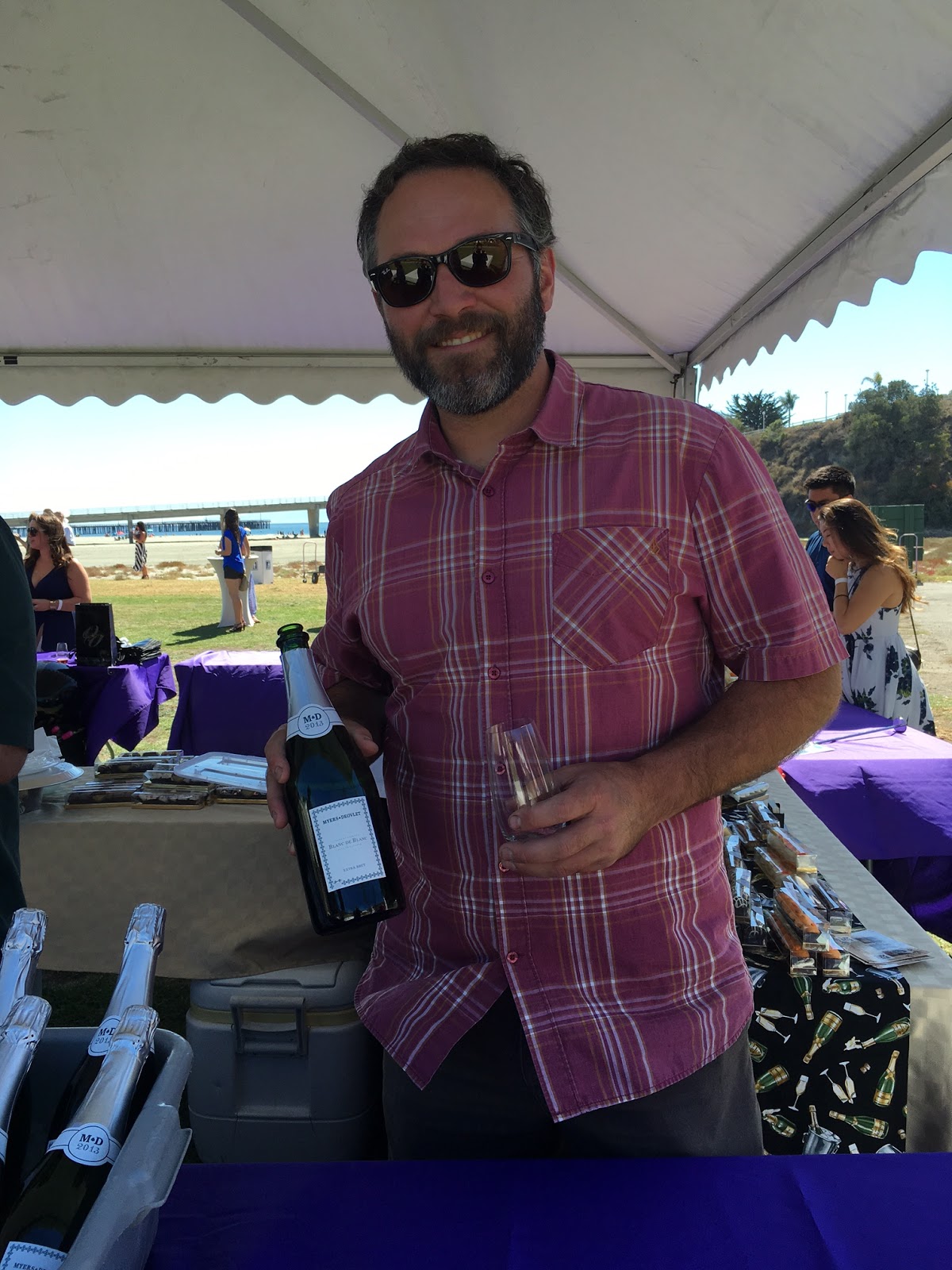
The Grand Tasting is the largest event at Bubblyfest. Over 60 wineries poured selections from their sparkling collections. What I liked about the event is that it was outside with PLENTY of space. A lot of these big tasting events can be indoors in way too crowded rooms. Also, all the vendors were tented, which made the event more comfortable for everyone to enjoy. Highlights are below!


J Winery Brut 2009 Vintage

Myers Deovlet Blanc de Blanc Extra Brut

Derby Blanc de Noirs

Riedel Masterclass Glass Seminar

This was a unique and fascinating wine glass tasting, conducted by Riedel Ambassador Susan Dubrow. Susan masterfully demonstrated the relationship between the shape of a glass and our perception and enjoyment of wines. We had 4 different glasses in front of us: a New World Pinot glass, a Chardonnay glass, a Champagne glass, and a Champagne flute. We also had some wine pours in front of us in plastic cups: an oaked Chardonnay, an Oregon Pinot, and a Champagne. Lastly, we had different flavors of Lindt chocolates in front of each glass. The seminar involved tasting the various wines out of various glasses. It was CRAZY how different a wine can taste out of each glass. I’m not a big proponent of advocating for people to go out and buy millions of different glassware, but this seminar made it clear that having at least a couple different glass shapes is worthwhile. The chocolate pairings were just for fun, but oh were they delicious.


Overall, this was a VERY well executed weekend festival. Lots of pre-communication emails, educational (yet fun) seminars, a great cocktail party, and a manageable tasting event. Bravo to the entire team who helped put it all together! I will definitely be back for Bubblyfest 2017!

Friday, October 7, 2016

Bubbles, Bubbles, and More Bubbles

Photo credit: Jeremy Ball

Today I am making the drive up the coast to Avila Beach for Bubblyfest. Bubblyfest is the definitive festival for all things sparkling! In fact it is the only dedicated sparkling wine festival in the United States (that I know of!). Thank you to Create Promotions for granting me a press pass to cover the event. Stay tuned for my bubbly-related posts both before and after I attend Bubblyfest events such as: seminars, grand tastings, and even a 1920s themed cocktail reception! Also, follow me on Twitter @SOMMspirations for an up-close look at all the Bubblyfest events! Ok, back to the juice.

One of the most oft misused wine terms is “Champagne”. Similar to how the word “Kleenex” is synonymous with tissue, in our cultural lexicon, “Champagne” is synonymous with any sparkling wine. If you are drinking a wine in which the grapes were grown in the Champagne region of France, you are in fact drinking Champagne. If the grapes were grown anywhere outside of the Champagne region, then it may not be referred to as Champagne. Well then, what is it to be called? Below is a list of different types of sparkling wines. Yes, there are more than these, but I chose to highlight the most popular styles.

*Note that I referred to Jancis Robinson’s Oxford Companion to Wine for some of the technical information and definitions. I affectionately refer to this book as “The Bible”. In my religion, Jancis is the patron saint of wine. Yes, I’m Jewish, but that’s besides the point.

Types of sparkling wine:

Champagne. Oh Champagne. Where do I start? As mentioned above, sparkling wine can only be called Champagne if the grapes are grown in the Champagne region of France, which includes Montagne de Reims, Cote des Blancs, Vallee de la Marne, Cote de Sezanne, and Cote des Bar. Aside from region, there are other rules that need to be adhered to in order to call it Champagne. The grapes can only be: Chardonnay, Pinot Noir, and Pinot Meunier. Also, the bubbles in the wine need to be created by the methode champenoise. This means that the second fermentation happens in the bottle in which the wine is sold. A base wine is made and bottled with an addition of sugar and yeast (liqueur de tirage). The bottle is closed with a crown cap and the second fermentation will happen in the bottle, creating bubbles...voila! There are a few other steps, but those are the basics to get you started. See my previous post entitled “How Do Bubbles Get in Bubbly?”. Champagne is a wonderful thing. It used to be served only on celebratory occasions, but now the tides are turning. See HERE for an article that NPR came out with last week. I personally prefer to imbibe Champagne when I am in the mood to pay attention. I LOVE to savor all the notes that come with Champagne including: toastiness, yeastiness, and a leesy quality.

Photo Credit: thetipsygrape.com


Cremant. It’s easier to start with what Cremant isn’t. Cremant isn’t Champagne. Cremant is the term used to describe any sparkling wine in France (outside of Champagne) that is still made in the traditional method (known as methode champenoise in Champagne). Familiar cremants include Cremant de: Bourgogne, Loire, Alsace, Jura, Limoux or Bordeaux. Grape varieties vary by region. Cremants are useful when you don’t want to spend as much on your bubbly. Many Cremants can be had for $12-$20, whereas the bulk of Champagne is over the $35-$40 mark.

Cava. Cava is a Spanish sparkling wine also made in the traditional method. Cava is predominantly made in Catalunya (though production in a few other regions is allowed). The three main grapes used are Macabeo, Parellada, and Xarel-lo, though the trend is moving towards including traditional Champagne grapes, mainly Chardonnay, much to the dismay of Cava traditionalists. Cava generally has a zesty citrus/lemon note, acidity, and a nice nuttiness. I’d describe it as a bit easier to drink than Champagne. I choose Cava when I want a less serious bubbly and when I want to save a bit of money. You can generally find Cava in the $10-$20 range.

Prosecco. Prosecco is an Italian sparkling wine made in the Veneto region. By volume, it is the most produced and consumed sparkling wine in the world. The varietal is Glera, also known as the Prosecco grape. Prosecco is made in the tank method, which means that the second fermentation (how the bubbles are created) takes place in a tank versus in a bottle. This production method is much cheaper than doing the second fermentation in the bottle. A Prosecco is going to be much fruitier than the other types of sparkling wines discussed. Prosecco is frothy, usually has some residual sugar, and has fruity and floral notes. Basically, I use Prosecco as my brunch bubbly. It’s not too serious, good with food, and goes down easy when you’re drinking at 10am! A decent Prosecco can be had for $12-$15.

Lambrusco. You might not know that you’ve had Lambrusco, but if you’ve had a chilled sparkling red wine, it probably was Lambrusco. Lambrusco is an ancient varietal grown mostly in central Italy in the Emilia-Romagna region. It is also the name of the sparkling wine made with that grape. Lambrusco was HUGE in the 70s in the US. A little brand named Riunite cornered the market and many Americans in that time period had experience with a (probably sweet) Lambrusco. Lambrusco has now grown up and it is no longer your grandma’s wine. Many producers are vinifying the wine dry or off-dry. Lambrusco has a nice food-friendly acidity, a tannic grip, and notes of berry. It pairs well with cured meats and hard cheeses. Typically, a good bottle of Lambrusco can be had for $14-$18. As a general rule, you’ll never pay more than $20 for a bottle.


Franciacorta. This one you might not have tasted, as a huge percentage of the production stays in Italy. But, if you ever get a chance to try one, I highly recommend it. Franciacorta is Italy’s answer to a high-quality sparkling wine made in the traditional method. Franciacorta is made in the Lombardia region with grapes such as: Chardonnay, Pinot Blanc, Pinot Noir, and Pinot Gris. It usually has extensive aging on the lees (what the hell does that mean? Read HERE) and thus has a nice yeasty, toasty note as does Champagne. Prices for Franciacorta are similar to Champagne.

Sparkling Wine. Are we done yet? Almost. I’ve highlighted many types of sparkling wine from around the world. You may be thinking: what about all the bubbly made in California, or that New Zealand sparkling you tried last week? Essentially, (most) all other sparkling wine around the world is called just that: sparkling wine. No fancy name, no delimited areas, no required grapes or production methods. This includes, but is not limited to any sparkling wine made in the US, New Zealand, South Africa, Australia, etc.

If you learn one thing today, it’s to learn how to order a glass of bubbly. If you’re specifically looking for say Champagne, Prosecco, or something of the like...say it! If you know that you want to drink something with effervescence, then ask if the establishment has any sparkling wine. My biggest pet peeve is if I ask if they have any sparkling wine, and they say “yeah, we have Champagne.” And pull out a Cava, or Prosecco. Or if I specifically ask for Champagne and they pull out something else. Look at it as your winely (I made that word up) duty to spread the good gospel of proper bubbly lingo!

From what I hear, there will be 70 sparkling wines available for tasting at Bubblyfest. That’s a lot of bubbles! I will definitely report back on some of my favorites. Remember to follow me on Twitter @SOMMSpirations to follow my Bubblyfest adventures! Below is an agenda of my trip:

Friday October 7


2:30pm-4:30pm Winemaker Seminar Series presented by San Francisco Wine School
Learn the origins of sparkling wine from the south of France to the south of England and eventually Champagne. Taste through Cremant and other sparkling wines from regions all around France to find out how they are different and why. Follow the evolution of global bubblies as they reached California and led to the wines of today. David Glancy will be joined by Pomar Junction, J Vineyards, and Riverbench to taste and talk about their sparklers to wrap up the session.

6pm-8pm Corks & Cocktails
Enjoy an evening under the stars, as our popular Gatsby inspired Cocktail Party returns for another jazz filled evening by the sea! Sip from 4 unique Sparkling Wine cocktails from recipes concocted by our partner Wineries, and Sparkling Wines by the glass.  Dance the night away to the gypsy jazz stylings of The Tipsy Gypsies.

Saturday October 8

11am-noon VIP Tasting
This one-hour tasting on the ocean view terrace at Avila Beach Golf Resort's Beach House will feature 4 highlighted wineries pouring 1 special bottle from their collection, not available at the Grand Tasting.

Noon-1pm Riedel Masterclass Glass Seminar
In a unique and fascinating wine glass tasting, Riedel Ambassador Susan Dubrow will demonstrate the relationship between the shape of a glass and our perception and enjoyment of wines.


Stay tuned for more from Bubblyfest!

Friday, September 9, 2016

Ode to Bubbles #MWWC27


**This post is being entered in the Monthly Wine Writing Challenge hosted by wine blogger, The Drunken Cyclist. See more details HERE. The winner last month was my blogger buddy Jim of JvB Uncorked. He won with THIS POST on the topic of “solitude”.   Jim also selected the topic of “bubbles” for this month’s challenge. Enjoy!

**Voting began on Tuesday September 13.  Please vote HERE.

I remember that feeling of excitement when bubbles were blown in my vicinity when I was a little girl. The goal was to either catch them on your finger or pop them, but you pretty much HAD to get up and do something. Because…...BUBBLES! Fast forward 30 years and I pretty much still have the same reaction to bubbles, aka sparkling wine. I hear a cork pop, or I see a glass of sparkling wine and I just HAVE to get up and do something! My name is Brianne and I was a kid who loved bubbles and I am now an adult who loves bubbles. Bubbles are alive in the glass and somehow make life more exciting. 


Interestingly enough, sparkling wine was first made by mistake. Fizziness in wine was considered a fault during the winemaking process. At the risk of this post becoming a history lesson, let’s fast forward to a time when wine was intentionally made fizzy and consumed with bubbles. In a nutshell, sparkling wine was first made accidentally. Through years of trial and error, a sparking wine was successfully produced. Because of the involved process, sparking wine was more expensive than still wine, and hence became a drink of the wealthy upper class. It became a status symbol to have sparkling wine in your home and serve it at dinner or at an event. How is sparkling wine made? Take a look at my previous post HERE for a quick read on how bubbles get in bubbly.

Somewhere along the way, sparkling wine (mostly Champagne) became associated with celebration. It is served at important life events such as weddings, it is used in the symbolic gesture of a “toast”, and is also used to christen a ship before its maiden voyage.

Let us deconstruct the bubble. Sparkling wine (whether it’s Champagne, Cava, Prosecco, etc) is a sensory experience. We HEAR the “pop” of a cork after it is released from the bottle. Visually we SEE the bubbles race up the side of glass after the frothy liquid is poured. If you sniff a glass of Champagne, you can SMELL the yeasty lees on the nose. Put the juice in your mouth and you can TASTE the complexity and FEEL the effervescence of bubbles on your tongue.

Bottom line, Champagne is sexy as hell. The sensory experience above can be read as a step-by-step recounting of opening up and enjoying a bottle of Champagne, or it can be read as a metaphor for the excitement of being with a lover for the first time. The sounds of lovemaking, the smell of each other, the taste and feel of that lover on your lips, and final release. The parallels are clear. In fact the two are quite complementary. A glass of bubbles before or after lovemaking is quite extraordinary.

Sparkling wine is no longer something reserved for the upper class elite in society. That’s why god invented Andre and Cooks, both of which both clock in at about $4-$5 a bottle! Not my bubbles of choice, but there is something for everyone. We can all have the experience of a celebratory glass of bubbles. But why wait for a wedding or a toast? Let’s all enjoy bubbles when we please. There is nothing more satisfactory and pleasurable than sitting on the couch with a glass of bubbles on a Tuesday night while watching TV.

Bubbles are alive in your glass.  They are dynamic, moving, and ever-changing.  Like us.  So sit back, relax, and enjoy a glass of humanity.  Enjoy a glass of bubbles.  Why?  Because the meaning of life is to live it.

**Please vote HERE for this blog post in the Monthly Wine Writing Challenge.


Speaking of bubbles, in about a month I will be attending BubblyFest in Avila Beach. Bubblyfest is the definitive festival for all things sparkling! Thanks to Create Promotions for granting me a press pass to cover the event. Stay tuned for more bubbly related posts as I lead into the event!

Thursday, June 23, 2016

Orlando


It has been an interesting and full couple of weeks. For one, I took my WSET Fortified Wine exam on Tuesday June 14th. It was a doozy (aren’t they all?). And yet again we wait 8 weeks for these results.

The day I was to attend the BubblyFest LA PopUp was Sunday June 12. I awoke at 7am as I got to bed quite early the night before. When I woke up, I had multiple alerts on my phone from news outlets reporting that 20 people were killed at a gay nightclub in Orlando. To say this was shocking to read as soon as I opened my eyes is an understatement. It almost felt like a dream, or more accurately, a nightmare. Did that really happen? Were people butchered while out drinking and dancing? As many people thought “that could have been me”, within an hour or so, more alerts started coming and the headline was revised to state that 50 people were dead at the Pulse gay nightclub in Orlando. I felt disbelief upon reading this. I work in the LGBT community (as the Events & Tours Manager for the Gay Men’s Chorus of Los Angeles) and LGBT people make up an important and integral fabric of the people in my life. This didn’t feel like something that happened to “them”, this felt like something that happened to “us”. How could somebody do this? How could SO many innocent lives be lost. The numbers were staggering as my head and heart had trouble processing it all that day. My heart ached for the people who lost their lives. People who were fully self-expressed, dancing, and spending an evening out with friends. It was (and still is) just too much to absorb. I am still processing through my emotions about the tragic incident in Orlando. May we all appreciate each day a bit more and learn to live our lives without those 49 lives who were taken too soon.

The afternoon of the 12th I was honored to attend the BubblyFest LA PopUp at LA Mother with a press pass. I almost did not go. I “needed” to study for my exam, but mostly I needed to mourn. I spent most of that day crying, repeatedly watching the news, reading articles, emailing with friends, etc. I felt a bit lost that day, but I knew I owed it to myself to carry on. Carry on with life and with my passions. I studied as best as I could, and I chose to attend the BubblyFest LA PopUp event. And I am glad I did. It was nice to connect with people, albeit strangers. I felt myself look people in the eye a bit stronger, smile a bit longer, and to ultimately be present. Present to life, to each other, and even to wine. Wine is something that I love. It is a living breathing thing that Mother Earth so generously gives to us. For one hour on that Sunday I let go and enjoyed wine. Really simple. I went from table to table and sipped and enjoyed wines. Some of my highlights were from: Palmina Winery, J Vineyards & Winery, Hagafen Cellars, and Gruet Winery.

Tasting from Mia Rosa upon arrival 


I am happy to report that I have also been granted a press pass for the main event, BubblyFest by the Sea in Avila Beach, CA in October. BubblyFest is the only festival dedicated to Sparkling Wine in the United States. It is sure to be a tremendous event and I am honored to report on it. Stay tuned for posts leading up to the main event.

Tuesday, January 19, 2016

I Passed!


Great news to report!  I received word that I passed the two exams that I took in November.  What a relief!  I've been on pins and needles as our class had to wait 9 long weeks to get these results.

The first exam was Unit 5 Sparkling Wines. This exam consisted of 3 short answer questions on various topics related to sparkling wines and 3 blind tastes of sparkling wines.  I actually passed the tasting with Merit!  A pass is a grade between 55-64%.  Merit is 65-74% and Distinction is 75%+

The second exam was the Case Study, which is half of Unit 1 The Business of Wine.  The case study is a closed book paper that you write in a timed exam condition.   This case study was on supplier/retailer relationships, and I passed this one with Merit as well!

Wanted to share the good news with everyone.  I will be back shortly to report on the next unit that I just recently began: spirits!


Monday, October 5, 2015

It's Not You...It's Me

Getting Ready for a Sparkling Tasting Group
Hello readers!  As some of you may have noticed, my blogging has slowed down significantly over the last month or so.  I am coming up against one of the most challenging pieces of the Level 4 process.  On November 4, I have not one, but two exams that day.  The first exam will be an essay question/case study for Unit 1: The Business of Wine & Spirits.  In this exam I will have 65 minutes to write about 5-6 pages on a specific topic. The second exam will be on Unit 5: Sparkling Wine.  I will have 3 wines to blind taste and 3 short essay questions to answer. The short answers could be on ANY topic related to sparkling wine throughout the world, i.e. yeast autolysis, Vallee de la Marne, Cava, or blanc de blancs.  As you can see, I have a lot to cover in order to be prepared for that day!

I know the main purpose of this blog is for me to share my journey as I go through Level 4, however, I have decided that my studying takes precedence and I need to honor that time for this short window.  With a full-time job and studying, my schedule is packed!  Thank you for understanding.  My goal is to bring you relevant, interesting, and informative content, and I will get right back to that after November 4.  One post that I'd like to get up by the end of the year is a post about LA's Best Wine Shops. I have some gems that I'd love to share with you all!  Take care and wish me luck!!  Until November!

Continue to follow me on Facebook and Twitter, as I will be active!


Sunday, September 20, 2015

One Down, Five To Go!


Before I get to the final recap of my Wine Bloggers Conference trip to the Finger Lakes (post to follow on Tuesday!), I have some great news to share. I passed my first somm exam of the WSET Level 4 Diploma program! Over the course of 2 years, I have 6 exams to pass, corresponding to 6 different units. We began with Unit 2, which is viticulture and vinification, and this is the exam that I just passed. Currently we are working on both Unit 1 (The Business of Wine and Spirits) and Unit 5 (Sparkling Wines) concurrently. The exams for both units are on November 4. It will be a busy day of tests, and I will share more as my studies continue! Thank you readers for all the support and encouragement.


Sunday, September 6, 2015

Wine Bloggers Conference: Day 1

Veraison at Chateau Frank

Happy Labor Day weekend to my SOMMspirations readers! I’m enjoying a long weekend filled with wedding festivities (congrats Jon and Mel!) and the beach!  Before I delve into my recap of Day 1 in the Finger Lakes, I’d like to give everyone an update on my WEST studies, as a lot has transpired in the last couple of weeks.

As you all know, I am currently enrolled in the WSET Diploma Level 4 program. It is a two year course that consists of A LOT of studying (600 hours over 2 years, to be exact) and a series of exams over 6 units of study. On August 23rd I took the first exam, a 100 question multiple choice format, with the subject being: viticulture (the growing of grapes), vinification (the making of wine), maturation, and bottling. I can report that it was a TOUGH test, which threw me a bit. This exam has an average pass rate of about 90%, so there is a good chance that I did pass. But I am not 100% certain that I did...fairly certain, yes...100% certain, no. I should have my results in about a week or so, and will share with everyone once they come in! Looking forward, I have a full day of exams coming up on November 3rd: a blind tasting of 3 sparkling wines, a long-essay case study (the topic has not been released yet), and a few short answer questions on sparkling wines. More info to follow!

Back to the Finger Lakes! To start Day 1, the Wine Bloggers Conference opened with Karen MacNeil as our keynote speaker. MacNeil, the author of The Wine Bible, is the most authoritative American woman in the world of wine. MacNeil is a very poised and confident speaker. She has a sense of calm and beauty about her that translates in everything she says. MacNeil imparted her words of wisdom to us bloggers, who soaked it up like little sponges. She urged us to think through our story and develop our own style. Voice, she said, is not as important as style. I am not in 100% agreement on this, as I think when you get started, your voice is something that needs to be developed and honed in on. As a blogger, I am still trying to define my voice in this wine blogging world. Simultaneously, I am working on maintaining a style as well, but for me, I find voice to be tantamount to style. She also told us to agonize over our writing. MacNeil is a perfectionist and this is not a secret. You can tell in the way she carries herself and in how she speaks (in person, as well as in her writing). Your writing will live out there in the world with MANY other pieces of work. With that many options for people to choose from, yours must be of quality. Also, you must tell your story, she said, don’t just write it. Anyone can write or recount a story, but not all can TELL a story. You must know wine deeply. Wine, she said, should never be stripped of its culture. For example, there is no way to understand Malbec, if you don’t understand tango. That sums up how I feel about wine. There is SOMETHING about wine that is more than just fermented grape juice in a bottle. Wine is a story and is constantly evolving.

The next session was an “Introduction to the Finger Lakes Wine Country” panel. The panelists included: Alan Lasko, a fruit crop physiologist from Cornell University, Christopher Bates, a somm, chef, and winemaker at Element Winery, and Fred Merwarth, the owner, winemaker, and vineyard manager at Hermann J. Wiemer Vineyard. This panel was particularly interesting to me because I knew almost nothing about the Finger Lakes to begin with. Some interesting facts I learned were that the Lakes exist because of ancient glaciation in the region, the lakes are very deep (Seneca Lakes at 650’ is the deepest), and that winemaking here is VERY difficult due to the climate, which can be extreme and unpredictable. The message that all the panelists conveyed was that those who come to the Finger Lakes to make wine, do so because they want to take on a challenge. Winemakers come to NY to become better winemakers, because it is not easy here. You have to work to make good wine here. Chris Bates, the only MS in the world who has presided over a kitchen, shared a strong message with us. He wants to get Finger Lakes wine out of the Finger Lakes. Most of the local wine is consumed here. The problem is that people outside of the NY do not know much about Finger Lakes wine because they are rarely exposed to it. His approach is to allocate a large chunk of NY wine to the state, but to also allocate a portion to other states so that people can get more experience with it.

The next part of the day was one of my favorites. We had an opportunity to taste 10 local Finger Lakes wines (all whites) in 60 minutes and live blog/tweet about them. You can imagine that we had some pressure on us. For one, we had such little time to taste, collect our thoughts, and to post. Also, we had to do this with the winemakers standing in front of us! We were all seated at round tables with our wine glasses and ipads ready. One winemaker started at each table and we had a total of 5 minutes to: hear about the wine, pour the wine, and tweet about the wine. Once the 5 minutes ended, the winemakers rotated tables.  It was a wine whirlwind, yet I loved every minute! Here is one of my tweets from that session:

Brianne Cohen ‏@SOMMspirations Aug 14
Starting with @DrFrankWine. Riesling Cremant. Dry bready nose. Green apple and white flowers. A nice Wednesday night bubbly. #wbc15

In case you thought that was the end of the day, you’re wrong! We still had a Finger Lakes excursion on the agenda. A bank of buses met us at the hotel and we had to jump on board one of them to find out where we were headed. Every bus had a different itinerary, which we did not know ahead of time. I was lucky, because in my opinion, I hopped on the best bus! We headed to a couple Keuka Lake wineries including Chateau Frank and the Pleasant Valley Wine Co. We first stopped at the sparkling winemaking facilities of the Frank family, Chateau Frank. Dr. Konstantin Frank was a Ukranian immigrant with a PhD in viticulture who came to the US in the early 50s. Dr. Frank is credited as one of the first people to successfully grow vitis vinifera grapes in the NE United States. We received a private tour by Fred Frank (Konstantin’s grandson) who now runs the family business. It was an incredible experience as we were in the private areas where the Chateau sparklings are made, in a beautiful building that is over 100 years old. We also had the opportunity to meet Fred’s daughter, Meghan, who is poised to take over the business as the 4th generation winemaker in the family. While there we enjoyed some sparklings from Chateau Frank, Ravine’s Wine Cellars, and Heron Hill Winery; all while overlooking the beautiful Keuka Lake at sunset. The setting was idyllic. I even walked over the vines and saw a lovely example of veraison in full effect (see picture above).
Riddling at Chateau Frank

View of Keuka Lake from Chateau Frank

The afternoon was complete once we made our way to Pleasant Valley Wine Company (aka Great Western Winery). Fun fact: Pleasant Valley Wine Co. is the oldest bonded winery in the United States, and their stone buildings onsite are listed on the National Register of Historic Places. We had a very memorable dinner at the estate in a beautiful, old cellar room. Our dinner was served and paired with wines from Dr. Frank and Ravine’s. It was a lovely evening as we were all seated with local winemakers and winery representatives and were able to get very intimate with the wine and hear even more about the Finger Lakes region. Overall, it was a very special trip and I am so glad that I had the opportunity to explore the Finger Lakes region, if only for a few hours. The love of the region by the winemakers is palpable. Finger Lakes is making honest, regional wines, and I am more than happy to support them!
Great Western Winery Champagne upon arrival!

Stay tunes for my next post, which will document Day 2 of my Finger Lakes trip to the Wine Bloggers Conference. Have a wonderful Labor Day!